Most construction and infrastructure businesses can tell you whether a job made money—eventually. Real-time job costing changes that. Instead of waiting weeks for dockets or tickets to be keyed in, payroll reconciled, and costs matched back against the bid, Assignar Pay shows your margin while the work is still happening. Because the question a serious contractor really wants answered isn’t “did we make money?” months later—it’s “are we making money right now, on this job, today?”, while there’s still time to do something about it.
The job costing data you were never capturing before
Assignar Pay is more than a pipe between the field and your accounting system. It captures information most businesses never had in a usable form: what actually happened on site, costed against the bid, as it happens. Hours, plant usage, allocations, and quantities are captured in the field, interpreted against your contracts and pay rules, and mapped to the right job, phase, and cost code—the same structure your ERP already uses. The moment a timesheet is submitted, it runs through your pay rates — so you immediately see the true cost of that work, split into regular time, overtime, allowances, and the additional labour burden most systems only surface weeks later. That fully-loaded labour cost is what flows straight into job costing.
That means the raw material of profitability—real cost against real budget, line by line—stops living on paper, in spreadsheets, or in someone’s head until the end of the month. This is the raw material of real-time job costing. Instead of reconstructing what a job cost after the fact, you watch it form while you can still influence the outcome.
Real-time job costing: will you make money on this job?
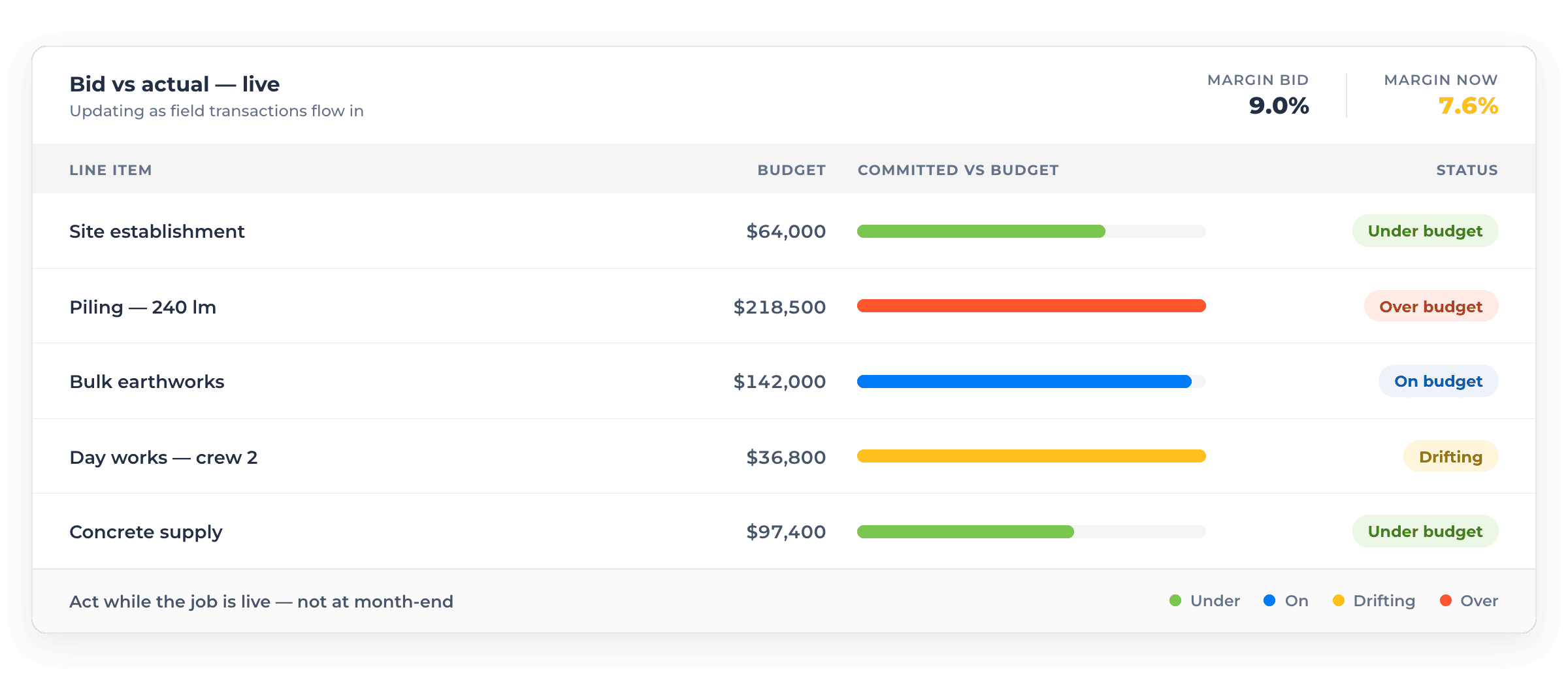
Load a bid into Assignar Pay and it builds out the items and activities that make up the work. As field transactions flow in, it tracks bid-versus-actual on every line—what you estimated to install a run of piles, say, against what it’s actually costing as the crews work. Each line is flagged on, under, or over budget, so you’re not waiting for a month-end report to learn a job is drifting. And because job costing now runs on your actual pay rates, that cost is real, not estimated. If a crew puts in a stretch of overtime today, those extra dollars show up against the job today — not after payroll runs at month-end. The margin you’re watching reflects what the work is genuinely costing, right down to the overtime.
This is the forward-looking view that changes how a job is run. When you can see committed cost against budget in real time, you can act while the job is live—rebalance a crew, tighten day works, or escalate a problem before it compounds. The margin you bid becomes the margin you defend, not the margin you discover.
Illustrative example. Figures are indicative and not drawn from a specific project.
Did you make money—and how to bid the next one better
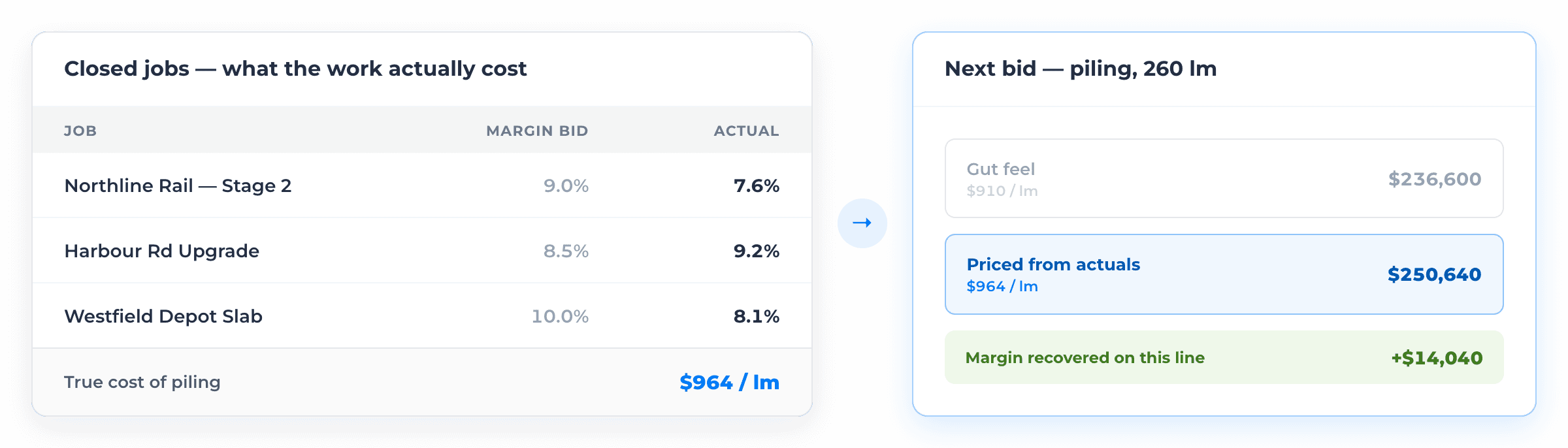
When the job closes, the same data answers the retrospective question cleanly: did we make money, and where exactly did the margin come from or go? Because every line was captured and costed as it happened, the post-job picture isn’t a reconstruction—it’s a record.
And that record compounds. Over time your system and your team build a real history of what work actually costs, not what you hoped it would—a running picture of job profitability you can trust. Estimators bid the next job against reality instead of gut feel. The businesses that win consistently aren’t only the ones that deliver well—they’re the ones that bid well, and bidding well comes from knowing your true costs. Every job you run through Assignar Pay makes the next bid sharper and more profitable.
Illustrative example. Figures are indicative and not drawn from a specific project.
Catch the change order early
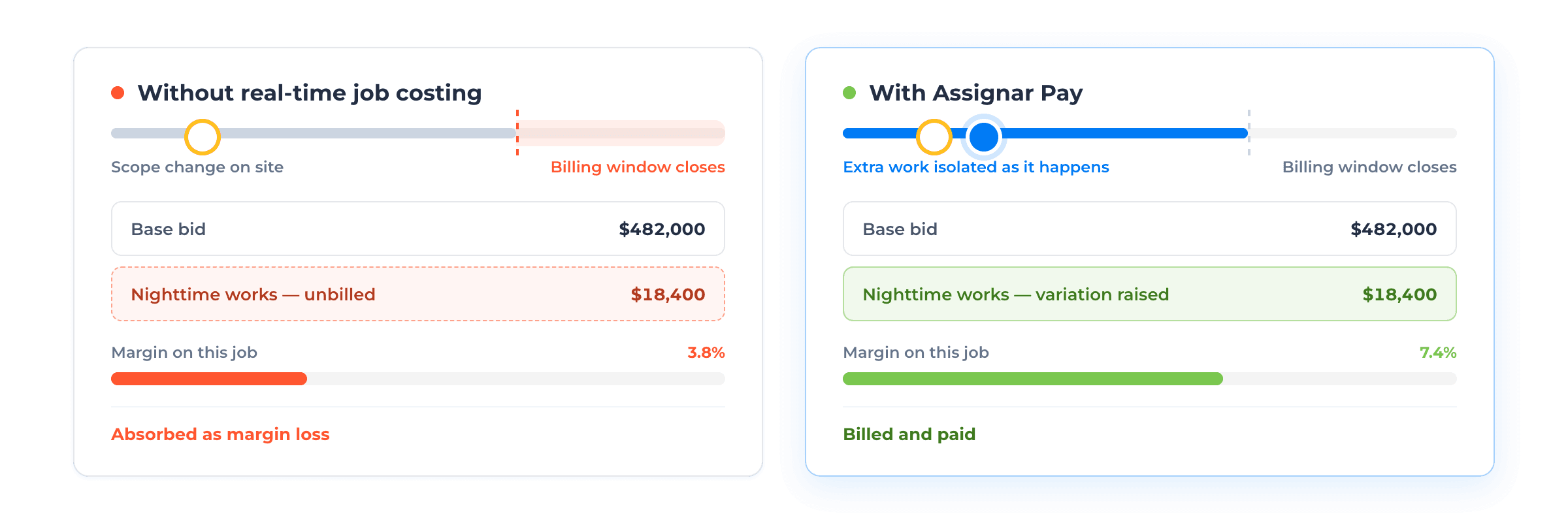
Some of the biggest margin leaks in construction aren’t overruns—they’re work you did and never billed for. A scope change happens on site, the crew gets on with it, and the paperwork to capture it as a variation (or change order) never catches up. By the time finance notices, the window to raise it has closed and the cost becomes a loss you simply absorb.
Because Assignar Pay isolates extra work as it happens—a nighttime-works order sitting on top of a base bid, for instance—that signal shows up early, while there’s still time to raise the change order or variation and actually get paid for it. Catching that on even a handful of jobs a year is often the difference between a healthy margin and a thin one.
Illustrative example. Figures are indicative and not drawn from a specific project.
Where real-time job costing meets your ERP
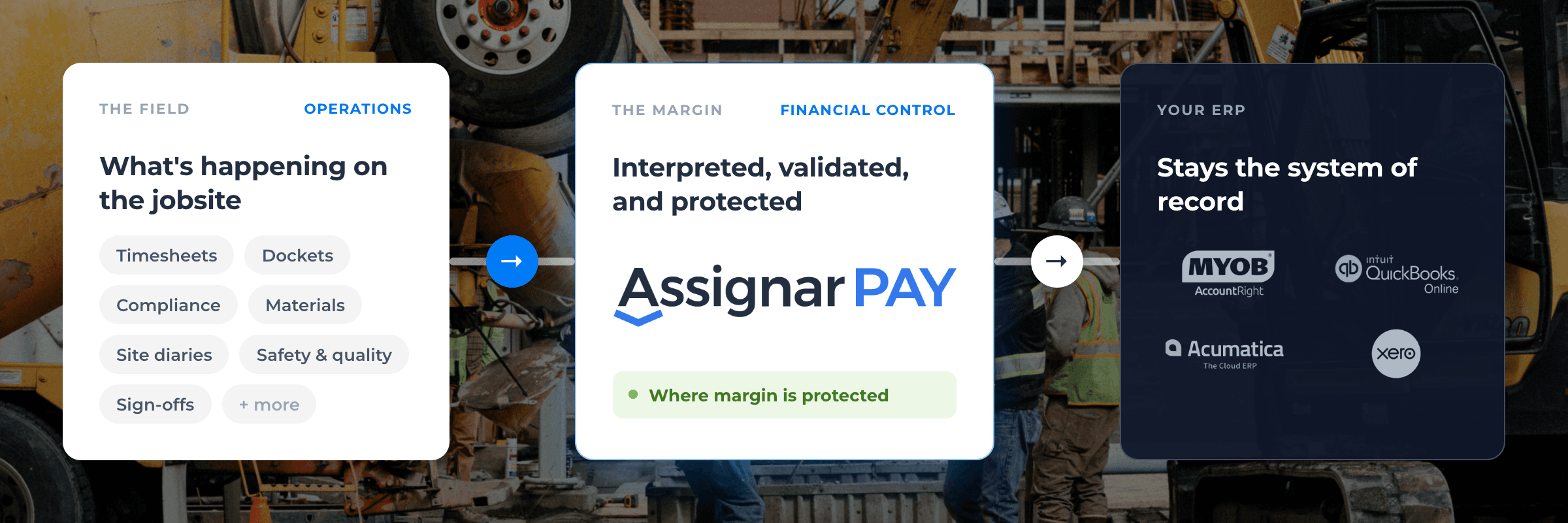
None of this asks you to replace the finance platform your business runs on. Your ERP stays the system of record—the ledger, the audit trail, where finance reconciles and compliance sits. Assignar Pay sits in front of it, doing the interpretation and validation, then hands the ERP clean, structured, already-coded data instead of a pile of paper dockets or tickets.
The handoff is deliberate. Interpreted payroll can be exported to your ERP to process there; invoice line items land coded to the class or inventory codes your accounting system uses; you can even push transaction line items across so invoices are created inside the ERP rather than out of a separate system. Ready-made export formats for the common platforms—MYOB, Xero, QuickBooks, Acumatica, and others—are enabled per organisation, and the movement itself can happen by export or CSV import, or automatically through an integration partner. Either way the ERP remains the master; it just gets fed faster, cleaner data, so the books close more quickly and real-time job costing reflects reality while the work is still live.
That’s the part that matters more than any label. It isn’t really about “integration” as a feature—it’s about how the field, the numbers, and the finance platform finally fit together into a single, live picture of whether you’re making money.
The bottom line
You shouldn’t have to wait until a job is over to find out whether it made money. Assignar Pay turns what’s happening in the field into real-time margin visibility—a forward-looking answer to “will this job be profitable?”, a clean retrospective answer to “did it?”, and a growing base of real cost data that makes every future bid sharper. Your ERP stays firmly in charge of the numbers; Assignar Pay just makes sure those numbers reflect the job as it’s actually running.
If you want to see how Assignar Pay protects your margins and connects to your ERP, book a demo or explore your options.
Article written by Graham Garvin, Director of Product at Assignar, a construction operations and financials platform used by contractors across Australia, New Zealand, and North America.